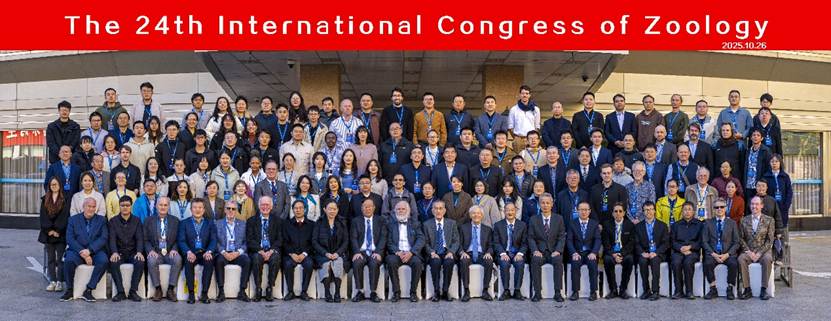
Group Photo
The 24th International Zoological Congress was successfully held at the Being Shengli Hotel in Beijing, from October 26 to 29, 2025. The Congress brought together over 200 scientists and students from more than 20 countries. Under the theme "Biological Consequences of Global Changes," experts engaged in in-depth discussions on the impacts of global change on wildlife. Key topics included biodiversity loss, biological invasions, outbreaks of biological disasters, disease transmission, and wildlife resource management. The Congress was organized by the International Society of Zoological Sciences (ISZS); hosted by the Institute of Zoology of the Chinese Academy of Sciences, the School of Ecology and the Hainan International One Health Institute of Hainan University; Supported by the Department of International Affairs of China Association of Science and Technology, the Bureau of International Cooperation of the Chinese Academy of Sciences, the Beijing Association for Science and Technology, the Beijing International Science and Technology Exchange Center, the International Union of Biological Sciences (IUBS), the Alliance of National and International Science Organizations for the Belt and Road Regions (ANSO), and Integrative Zoology.
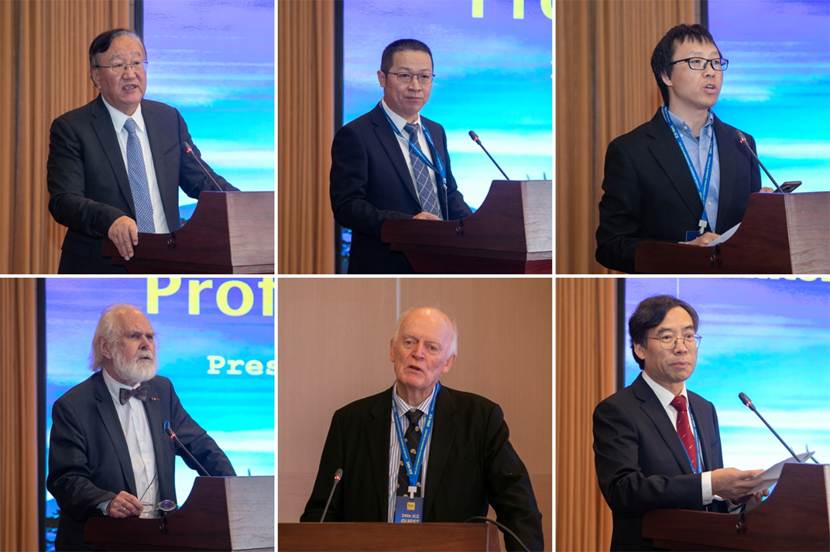
The opening ceremony of the Congress was presided over by Professor Zhibin Zhang, Executive Director of the International Society of Zoological Sciences (ISZS).
Professor Le Kang, Vice President of the International Union of Biological Sciences (IUBS) and Academician of the Chinese Academy of Sciences, delivered the first address. He stated that the core mission of IUBS is to advance the global development of biological sciences by promoting transnational and interdisciplinary research, thereby addressing the most fundamental scientific challenges and societal needs facing humanity. He noted that the long-standing collaboration between IUBS and ISZS has yielded a series of significant achievements. Looking ahead, IUBS hopes to further strengthen cooperation with ISZS to create a favorable environment for the development and exchange of global biological sciences. He concluded by wishing the Congress a complete success.
Opening Ceremony and Remarks
Professor Xiangjiang Zhan, Deputy Director of the Institute of Zoology, Chinese Academy of Sciences, delivered a speech. He began with a brief introduction to the developmental history of the Institute of Zoology, CAS, as well as the establishment and evolution of ISZS. He emphasized that over its more than 20 years of development, ISZS has achieved remarkable accomplishments. He highlighted that the current President of ISZS, Nils Stenseth, and Executive Committee Member Yvon Le Maho, were awarded the International Science and Technology Cooperation Award of the People's Republic of China and the Chinese Government Friendship Award, respectively. He also mentioned that ISZS has launched the World Wildlife Diseases Research Network initiative, which has already established collaborations with numerous organizations and holds promising prospects. The Institute of Zoology, CAS will continue its unwavering support for the work of ISZS.
Xian Yijie, Deputy Director of the Office of the Chinese National Committee for Man and the Biosphere, stated in his address that the Chinese National Committee for Man and the Biosphere and ISZS have maintained long-term and close cooperation in various areas, including animal monitoring in protected areas and science education, achieving significant results. He highlighted their collaborative efforts in conducting intelligent wildlife monitoring at the Chebaling National Nature Reserve in Guangdong Province and organizing animal monitoring training programs in multiple protected areas. The Chinese National Committee for Man and the Biosphere looks forward to expanding and deepening cooperation with the ISZS.
Professor Nils Stenseth, President of ISZS, Academician of the European Academy of Sciences, Foreign Academician of the Chinese Academy of Sciences, and Foreign Associate of the National Academy of Sciences, USA, expressed in his speech that he was deeply honored to serve as President of ISZS and extended his sincere appreciation for the highly effective work carried out by the Society's Secretariat over the past four years. He emphasized that international scientific exchange serves as a vital driving force for scientific advancement and societal progress. Under the current circumstances, he urged that the Society should make new and greater contributions to promoting and enhancing global scientific collaboration.
Professor John Buckeridge, the inaugural President of ISZS, reflected on the Society's establishment and development from a historical perspective. He noted that ISZS was founded earlier this century in response to ecological and environmental challenges, with the aim of fostering interdisciplinary integration within the field. He expressed great excitement and pride in witnessing the Society's vigorous development today. He particularly thanked the Society's Secretariat for their dedicated efforts and expressed his hope that the incoming leadership would build upon this foundation to elevate the Society to new heights.
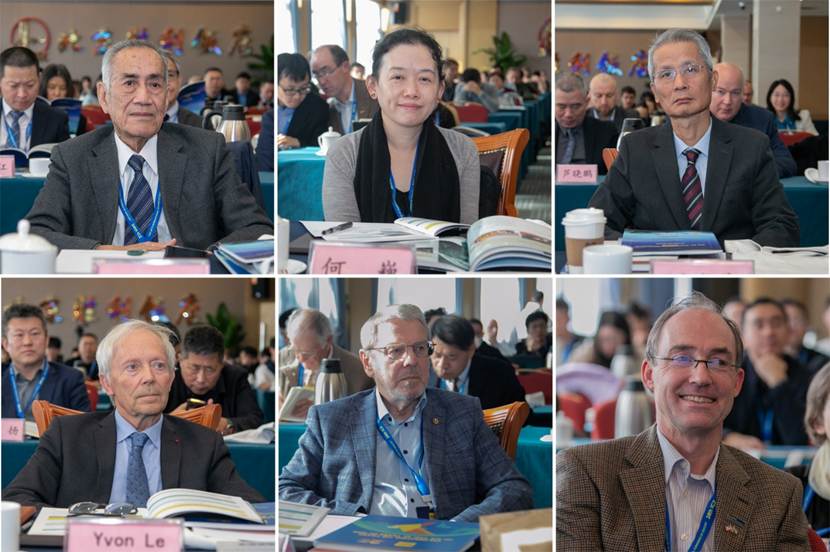
Some Guests of 24th ICZ
The Congress featured six plenary presentations, sixteen parallel symposia, one roundtable discussion, and an academic poster session. The titles of the plenary presentations are: “Conservation evolutionary biology of flagship species in China” by Fuwen Wei, Institute of Zoology, Chinese Academy of Sciences; "Wildlife decline and consequences in disease ecology" by Academician Rodolfo Dirzo, Stanford University; " Micro-environment and host parasite interactions in nestboxes occupied by Eurasian blue tits (Cyanistes caeruleus)" by Professor Santiago Merino, National Museum of Natural Sciences; " Urban marine reserves & sanctuaries and their contribution to biodiversity conservation" by Professor John Buckeridge, RMIT University; " Towards understanding the epigenetic regulation of vertebrate development and genome evolution – fish as a model " by Professor Hiroyuki Takeda, Kyoto Sangyo University; " Animals in plants' lives: the key elements of their mutualistic interactions " by Professor Pedro Jordano, Doñana Biological Station, Spanish National Research Council (CSIC).
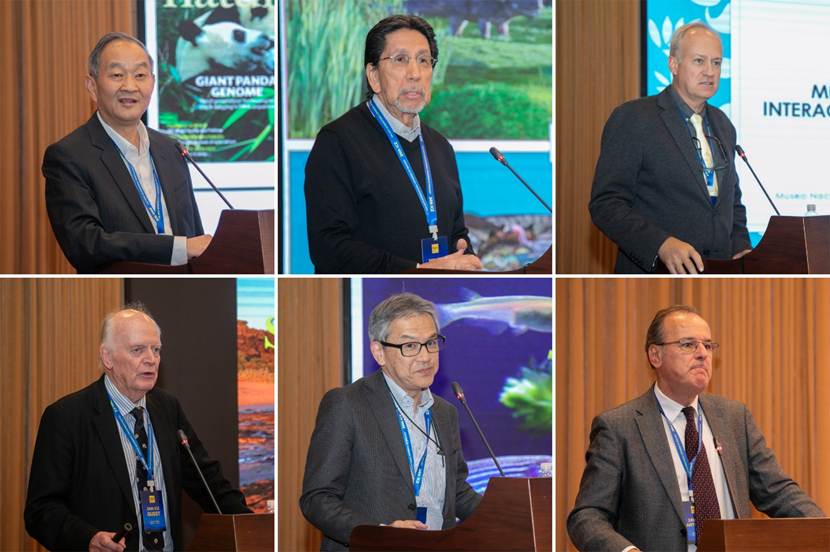
Speakers of plenary presentations
The topics of the 16 parallel sessions were: “Species monitoring in protected areas”; “Species interactions: implications for biodiversity conservation”; “Large carnivore conservation”; “Workshop of Beijing zoological societies”; “Rodent biology and ecological regulation”; “Animal physiology, life history and adaptation”; “Wildlife diseases”; “Global changes and biological invasions”; “Primate conservation promotes harmonious”; “Avian eco-evolutionary adaptation and conservation”; “Herpetological conservation in a changing world”; “Bioacoustics, the study of animal vocalizations”; “Wildlife diseases research network”; “ISZS young scientists group”; “CAST young elite scientists sponsorship program”; and “Animal responses to environmental pressures: from behavior to evolution”.
The sixteen symposia comprised a total of 161 oral presentations. A roundtable discussion was held on the topic of "One Health approaches to disease and pest management." Additionally, nearly 20 academic posters were presented during the Congress.
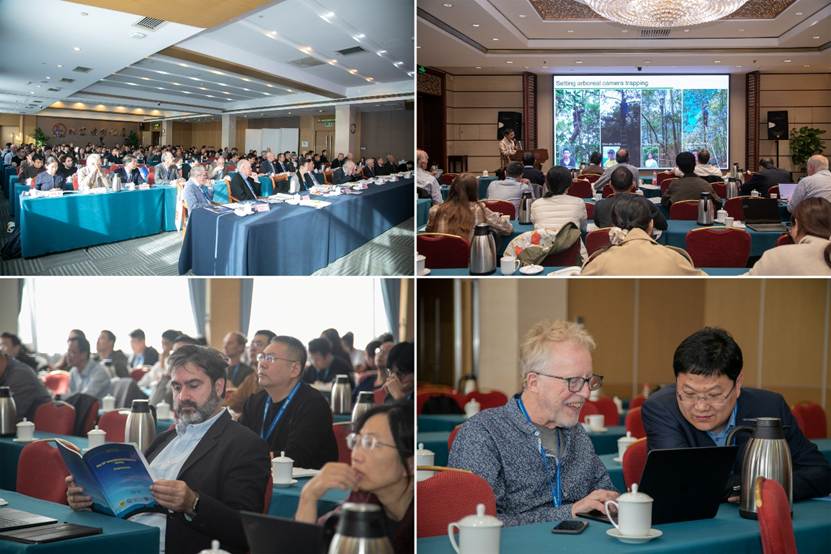
Venue of the 24th ICZ